

Is a semi-automatic filling machine sufficient for small-scale production?
In scenarios such as pharmaceuticals, medical aesthetics preparations, biological reagents, and laboratory small-scale production, most enterprises tend to fall into the misconception that "full automation is superior to semi-automation" when selecting filling machines. They blindly pursue integrated high-capacity equipment, resulting in mismatch between equipment investment and actual production capacity, leading to equipment idleness, cost waste, and low changeover efficiency. In fact, for small-scale production with a daily output of 500-5,000 bottles, a semi-automatic filling machine that is suitable is not only capable of meeting production needs but also can achieve the optimal balance of production capacity, compliance, and cost, without the need to overly pursue fully automated equipment.
The core pain points of small-scale production lie in unstable production capacity, frequent variety iterations, short changeover cycles, and controllable budget. At the same time, it needs to meet GMP compliance requirements. This is highly consistent with the core advantages of semi-automatic filling machines. Compared to fully automated filling machines, semi-automatic filling machines have the characteristics of convenient changeovers, low investment costs, and simple operation. They can precisely match small-scale multi-variety production scenarios, avoiding "wasting resources with excessive equipment", while ensuring production accuracy and compliance.
From the perspective of equipment compatibility, high-quality semi-automatic filling machines can achieve compatibility for multiple bottle types. For different small-dose bottle types such as eye drops with pointed tips, vials, and cartridge, no complex mechanical modifications are required; only parameter adjustments can complete the changeover, with a changeover cycle controlled within 5 minutes, significantly improving production flexibility and meeting the production needs of small-scale multi-variety production. At the same time, their filling accuracy can reach ±0.1ml, meeting the filling requirements for small-dose preparations, effectively reducing material loss and lowering production costs.
In terms of compliance and practicality, professional semi-automatic filling machines are all made of 316L stainless steel, with smooth surfaces that are easy to clean, in line with GMP aseptic production standards, and can be directly applied to high-standard production scenarios in pharmaceuticals and medical aesthetics without additional modifications to meet factory inspection requirements. Among them, the HONSIMB semi-automatic filling machine performs particularly well in this field. The equipment is equipped with an accurate flow control system, enabling semi-automatic feeding, automatic filling, and semi-automatic sealing for integrated operation. One to two people can complete the production process, with a daily production capacity of 500-5,000 bottles, perfectly meeting the production needs of small-scale production, while simplifying the operation process and reducing the maintenance cost of the equipment in the future.
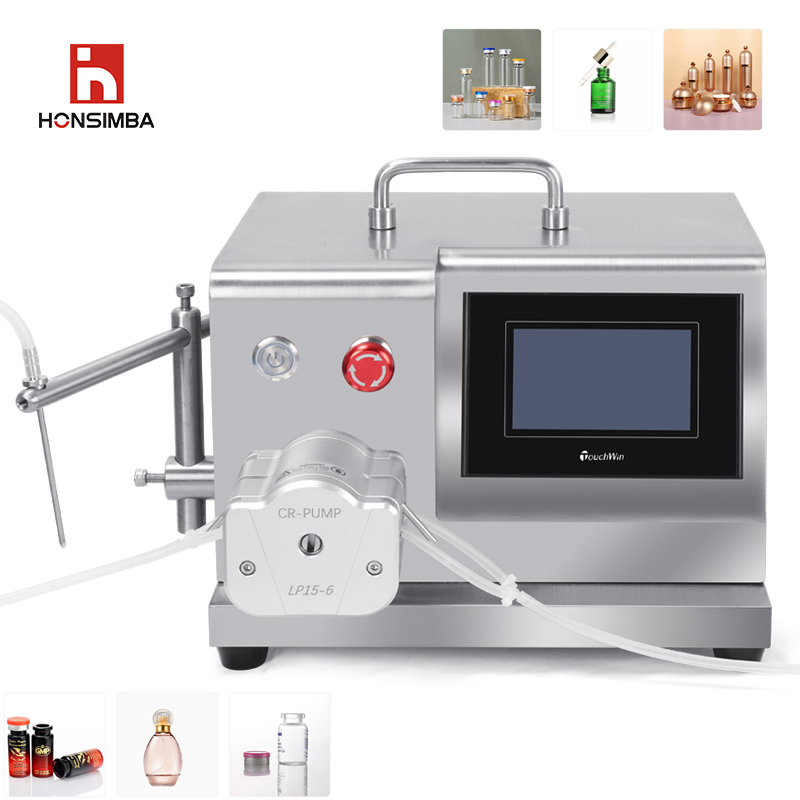
Some enterprises are concerned that semi-automatic filling machines have more manual intervention, which may affect production consistency and efficiency. In fact, professional semi-automatic filling machines can effectively avoid human operation errors through precise electrical control and mechanical structure design. The filling speed can be freely adjusted according to production needs, balancing production efficiency and product consistency. At the same time, the equipment body is compact, occupying a small floor space, and does not require a large amount of workshop space, suitable for scenarios with space limitations such as laboratories and small production workshops.
In conclusion, in small-scale production scenarios, semi-automatic filling machines can fully meet production needs and are more cost-effective and flexible compared to fully automated equipment. When selecting equipment, enterprises should base their choices on their own production capacity, variety, and budget requirements, choose professional equipment that is suitable, and avoid blindly pursuing highly-configured fully automated equipment. Through scientific selection, they can achieve dual optimization of production efficiency and cost, helping small-scale production progress steadily.