

How to configure a complete vial production line to save the most money?
For pharmaceutical companies, medical beauty institutions, laboratories, and start-up formulation enterprises, when building a complete vial production line, the core requirements are "satisfy production, comply with GMP standards, and have the best cost-effectiveness". Many customers blindly pursue fully automatic complete equipment, but end up spending a lot of money but not being able to use it; some customers only purchase single machines, resulting in poor connection and low efficiency, and even increasing costs. Based on years of equipment configuration experience, this article explains the most cost-effective vial production line configuration schemes in different scenarios, which neither wastes the budget nor fails to meet the production requirements.
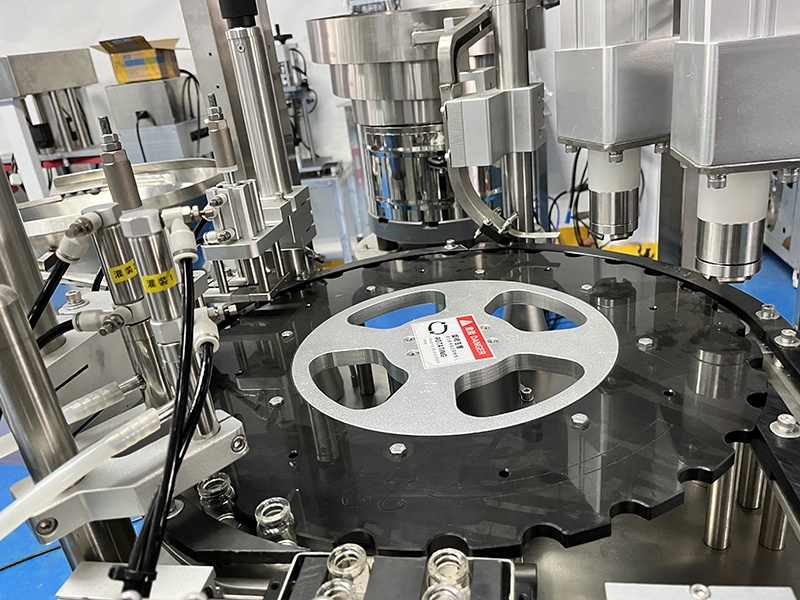
Firstly, clarify the core logic: saving money does not mean buying cheap equipment, but "matching according to needs, adapting to production capacity, and considering future upgrades", avoiding "using too much equipment for too little work" or "using small equipment for too much work". The core steps of a complete vial production line are: cleaning bottles → drying → filling → screwing caps → locking lids. The key to the configuration is "selecting semi-automatic and fully automatic combinations based on production capacity and scenarios, rather than choosing all fully automatic equipment".
Scenario 1: Laboratory/ R&D pilot production, small batch production (daily output 2000-5000 bottles), the most cost-effective configuration: semi-automatic single machine combination. The core principle is "enough is good enough", without pursuing integration, using single machines in conjunction, which reduces investment and is flexible and convenient. Specific configuration: semi-automatic bottle cleaning machine (suitable for small glass bottles, laboratory scenarios, keywords include laboratory bottle cleaning machine, small bottle cleaning machine) + small bench-type drying machine + semi-automatic vial filling machine + manual/handheld vacuum screwing machine + semi-automatic lid locking machine.
The advantage of this configuration is that the price of each single machine is low, and the total investment is only 1/3-1/4 of the fully automatic production line, and the changeover is flexible, suitable for multiple varieties and small batch trial production. The key is to choose core equipment with high cost-effectiveness, such as selecting 316L stainless steel material for the bottle cleaning machine to comply with GMP standards, and selecting high-precision ceramic pump models for the filling machine to avoid later maintenance and rework, which would increase costs.
Scenario 2: Medium batch production (daily output 20000-100000 bottles), the most cost-effective configuration: semi-automatic + fully automatic core equipment combination. Balancing efficiency and cost, avoiding high investment in fully automatic equipment, while solving the problem of low efficiency of single machines in conjunction. Specific configuration: semi-automatic cleaning + drying + fully automatic filling sealing integrated machine
No matter which configuration, the key to saving money also includes 3 points: First, choose to purchase from the original factory to avoid trade price hikes, and the equipment price can be reduced by 15%-30%; Second, prefer modular equipment to facilitate future upgrades and avoid repeated investment; Third, do not blindly pursue "high configuration", such as in laboratory scenarios, there is no need to select large fully automatic equipment, as long as it meets the basic GMP standards and production accuracy is sufficient.
In summary, the most cost-effective vial production line configuration is "matching production capacity according to needs, semi-automatic and fully automatic combination reasonably, and choosing equipment from the original factory". For small batch trial production, select semi-automatic single machines, and for medium batch production, focus on the automation of core steps. This not only meets production and compliance requirements but also maximally controls the budget, ensuring that every penny is used efficiently and avoiding waste.