

How to Choose a Sterilization Machine for Vial Washing? 2026 Guide for Enterprise Purchases
In industries such as pharmaceuticals, stem cell research, medical beauty preparations, and health supplements, the cleanliness of vials directly affects product quality, production compliance, and market competitiveness. As the front-end key equipment of an entire aseptic production line, the cleaning efficiency, operational stability, energy consumption cost, and compliance design of vial washing machines have increasingly gained attention from manufacturing enterprises. When faced with a wide variety of equipment on the market, how can enterprises scientifically and efficiently select a vial washing machine that truly suits their needs? This article, based on actual industry requirements, provides you with clear and practical purchasing ideas.
## 1. Prioritize the cleaning process: Cleanliness is the primary standard
The syringes are characterized by their small diameter, long body, and the tendency to retain impurities on the inner wall. Ordinary water washing is unable to meet the pharmaceutical-grade cleanliness requirements. A qualified bottle washing machine should have a complete multi-stage cleaning process, typically including ultrasonic rough washing, high-pressure circulating water rinsing, purified water/sterile water precision washing, and water and air alternation drying, among other procedures.
Multi-level spraying, no dead corners for rinsing, and a water-gas interchange structure can effectively remove particles, oil stains, and heat sources, ensuring that there are no residues or water marks inside the bottles, and meeting key detection indicators such as electrical conductivity and TOC. For pharmaceutical companies, whether they can successfully pass the GMP cleaning verification often begins with the front-end bottle washing process.
## 2. Appropriate capacity matching to avoid overcapacity or shortage
The bottle washing machine is the "first station" of the entire production line. Incompatibility in capacity will directly affect subsequent processes such as filling, capping, and drying. When purchasing, enterprises should select equipment with corresponding speeds based on their actual production volume and reserve 10% - 20% of redundant space to cope with peak production periods or future expansion needs.
The continuous operation structure is stable and efficient, suitable for medium and large-scale mass production; the intermittent structure is more suitable for small-batch and multi-batch production scenarios. Reasonable matching of production capacity can not only avoid resource waste but also ensure the smooth operation of the production line.
## III. Material and Structure Compliance, Conforming to Pharmaceutical Industry Standards
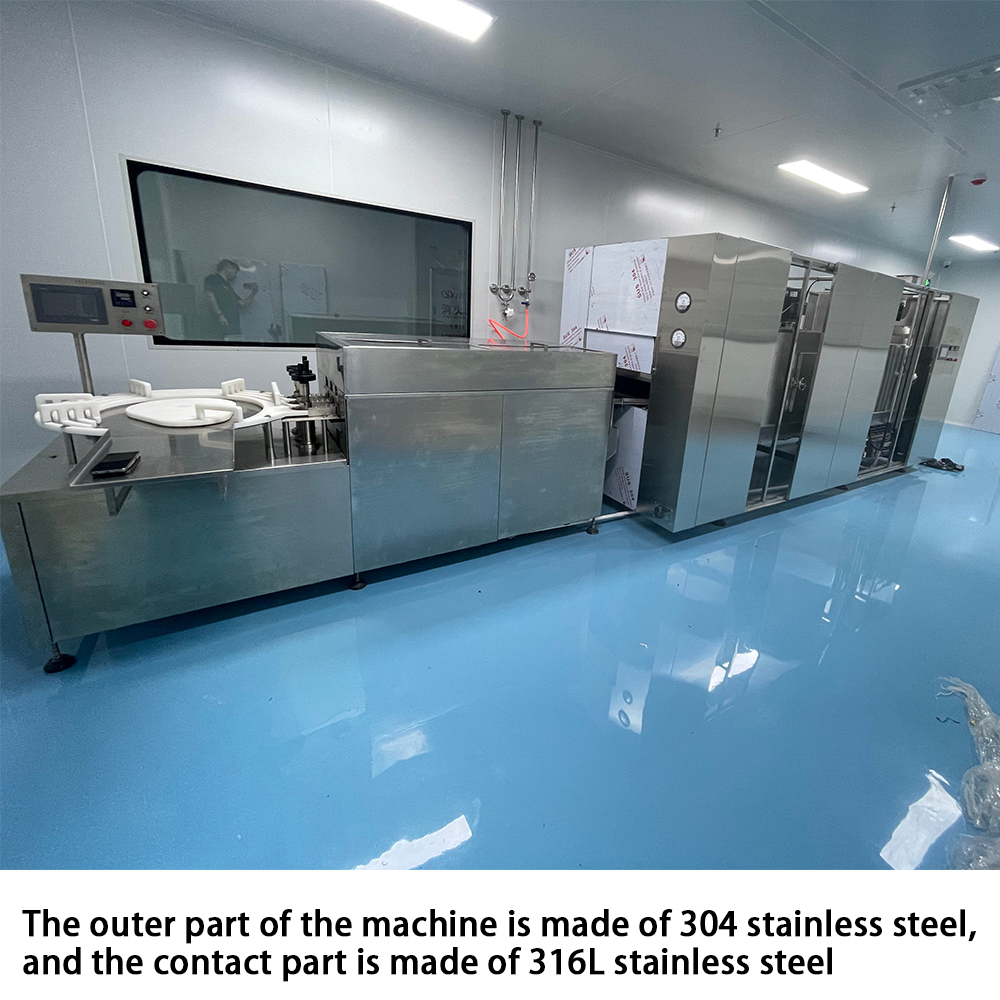
The pharmaceutical, medical aesthetics, and stem cell industries have extremely strict requirements for equipment hygiene. The areas in contact with water and the bottle body must be made of high-quality stainless steel, such as SUS316L. The frame part can be made of SUS304. The overall design of the equipment should have no dead corners, be easy to clean, prevent liquid accumulation, prevent residue, support online CIP cleaning, and reduce the risk of contamination.
At the same time, a standardized equipment structure, complete safety protection measures, and the ability to provide verification documents are all important conditions for enterprises to successfully pass the factory inspection and audit.
## 4. Low Bottle Breakage Rate and Low Failure Rate, Reducing Long-Term Operating Costs
The bottle breakage rate is one of the key indicators for evaluating the quality of a bottle washing machine. Broken bottles not only cause material loss but also may contaminate the equipment and lead to production line shutdown for cleaning. High-quality syringe bottle washing machines, through designs such as flexible bottle insertion, buffer flipping, and stable clamping, can control the bottle breakage rate at an extremely low level.
In addition, the durability of the core components, the stability of the entire machine's operation, and the ease of maintenance will all directly affect the long-term usage cost of the enterprise. The lower the failure rate and the shorter the downtime, the higher the production efficiency.
## 5. Professional After-sales Service and Technical Support to Ensure Long-Term Stable Operation of Equipment
The bottle washing machine is a high-precision automated device. When purchasing, one should not only focus on the equipment itself, but also assess the comprehensive service capabilities of the manufacturer: including on-site installation and commissioning, personnel training, rapid response for repairs, sufficient spare parts supply, and comprehensive verification data support.
Especially for export-oriented enterprises or multinational manufacturing companies, those manufacturers that can provide cross-border after-sales services and remote technical support can better ensure the long-term stable operation of the equipment and avoid huge losses caused by equipment downtime.
## Conclusion
Choosing a syringe bottle washing machine essentially means choosing a comprehensive solution that is clean, stable, compliant, and cost-effective. Only by comprehensively evaluating multiple aspects such as the cleaning process, bottle type compatibility, production capacity planning, material compliance, operational stability, intelligent level, and after-sales service, can one select the equipment that truly suits the development of the enterprise, and lay the first line of defense for high-quality production.
In today's era where industry standards are constantly rising, a high-performance and highly reliable capping machine for Westerly bottles is not only a production tool, but also a significant indicator of an enterprise's quality and competitiveness.