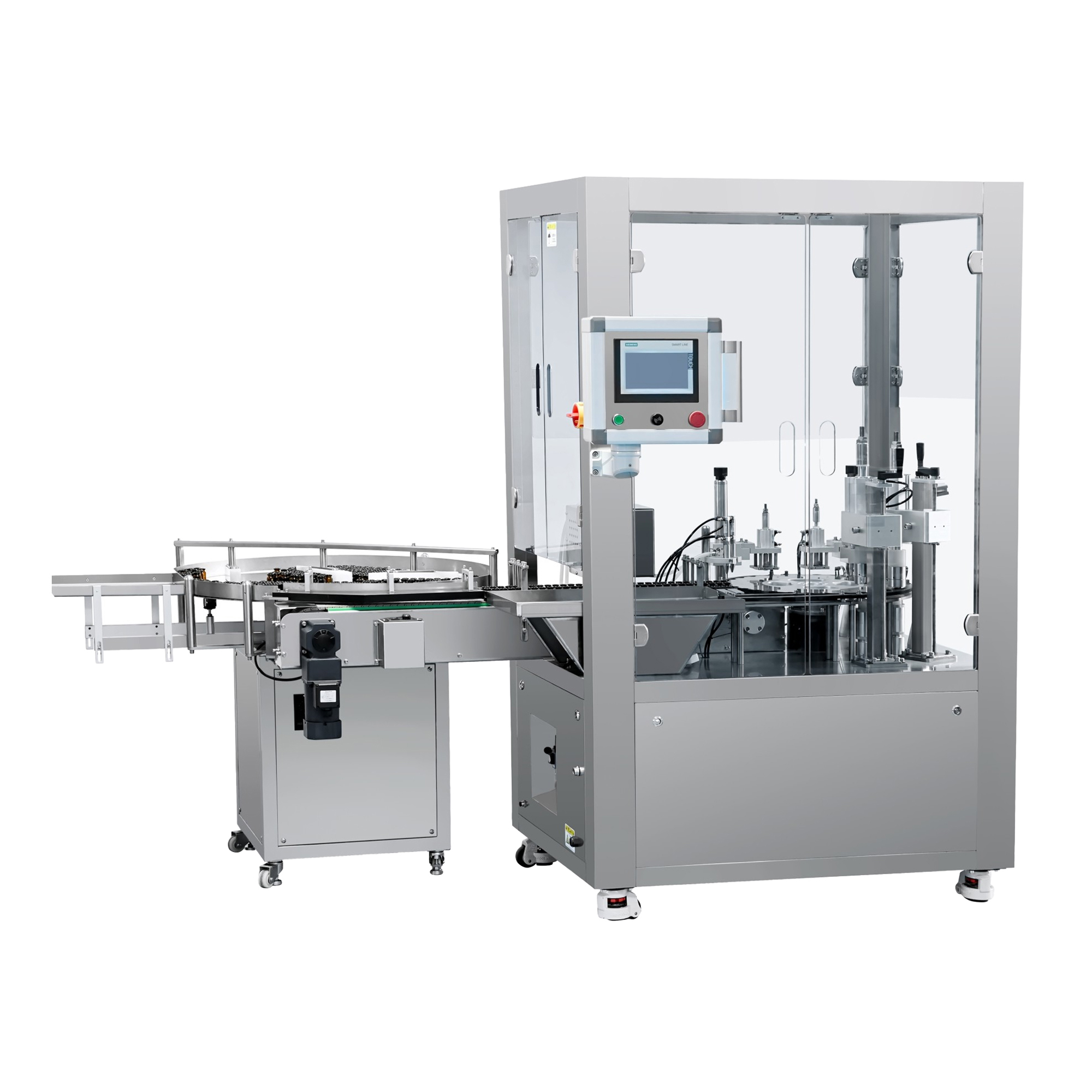
Why must we calculate the capacity gap of the number of filling heads?
In the packaging production of oral liquid, essential oil, reagent and washing liquid, the integrated equipment of filling, capping and labeling is the core bottleneck of the whole line. Many procurement models only compare the unit price, ignoring the capacity gap between single-head and multi-head models. The backlog of orders in peak season and idle waste of equipment in off-season often occur.
1.theoretical capacity (ideal non-stop state)
Theoretical capacity (bottle/hour) = number of filling heads × single head circulation output per minute ×60
Multi-head models are operated in parallel, and under the same beat, the theoretical capacity of multi-head ≈ single head capacity × number of heads;
Cap rolling and labeling are linked stations, and the theoretical production capacity of the whole line takes the slowest link among the three stations of filling, cap rolling and labeling to avoid bottle blockage caused by local overspeed.
2. Actual production capacity (factory real production)
Actual production capacity (bottles/hour) = theoretical production capacity × equipment comprehensive efficiency OEE
The routine value range of OEE is 70%–85%, and the sources of loss include bottle changing, pipeline cleaning, bottle cap filling, label connection, equipment spot inspection and material viscosity fluctuation.
3. Daily production capacity (8-hour single shift)
Actual production capacity per day = actual production capacity × effective startup time
Measured case: productivity calculation of single-head VS4-head filling and capping labeling machine
Set unified working conditions: low viscosity water agent, 50ml small round bottle, single-head stable 12 bottles per minute, OEE value of 80%, and effective start-up for 8 hours per shift.
① Single-head integrated model
Theoretical hourly capacity: 1×12×60=720 bottles/hour.
Actual hourly capacity: 720×80%=576 bottles/hour.
Daily capacity: 576×8=4608 bottles
② Four-head integrated model
Theoretical hourly capacity: 4×12×60=2880 bottles/hour.
Actual hourly capacity: 2880×80%=2304 bottles/hour.
Daily capacity: 2304×8=18432 bottles
Visual comparison of difference value
Under the same working conditions, the actual hourly capacity of the four-head model is four times that of the single head, and the daily capacity difference is 13,824 bottles;
Manual dimension: single-head machine needs two operators to watch the bottle loading and capping; The 4-head linkage model can be inspected by only one person, which has obvious advantages in long-term dilution of labor costs.