

How can one achieve true aseptic filling in vial liquid filling?
In the pharmaceutical, biological reagent, and medical aesthetic injection product industries, "aseptic" in vial liquid filling is an unbreakable bottom line. Many enterprises invest a large amount of cost to build aseptic workshops, but still encounter problems such as contamination of the liquid after filling, microbial over-limitation, and failure of GMP audits. The core reason is that they have not mastered the logic of full-process aseptic control. How can one truly achieve aseptic filling? We, based on years of industry practical experience, break down the key links, combine equipment advantages, and provide a feasible solution that can be implemented on the ground, helping enterprises completely avoid aseptic risks.
True aseptic filling, the first step is to secure "source asepsis" - the pre-treatment of the vial body and cap. During the production, storage, and transportation of vials, the inner and outer surfaces of the vials are prone to accumulate dust, fibers, and even microbial growth. If directly filled, the contamination risk is extremely high. Our equipment is equipped with an exclusive aseptic pre-treatment process. First, it undergoes 360° high-pressure aseptic air flushing inside the vial to neutralize the static electricity of the vial body and remove stubborn impurities. Then, it is dried by a hundred-level clean hot air. This ensures that there is no moisture or residue inside the vial. The cap is disinfected using ultraviolet and ozone dual disinfection, completely killing surface microorganisms, and cutting off the contamination path from the source, fully meeting GMP aseptic requirements.
The second step is to build a "process asepsis" - the closed loop of liquid storage and transportation. The purity of the liquid directly determines the aseptic effect. Ordinary equipment's open transportation is a major contamination hotspot. We use 316L hygienic grade stainless steel storage tanks, with mirror-polished inner walls without hygiene dead corners, to achieve online cleaning and disinfection (CIP/SIP); the transportation pipeline uses medical-grade aseptic silicone tubes, which are completely sealed and exposed, and is combined with two-stage precise filtration devices to intercept micro-particles in the liquid, avoiding contact between the liquid and air, impurities, and preventing secondary contamination.
The third step is to control the "core asepsis" - the detailed control of the filling process. Filling is the key to aseptic control and is also the most prone to errors. Our equipment uses servo-driven high-precision filling heads, with anti-drip and no-dripping design, to avoid spillage of the liquid causing contamination; the filling station is equipped with a hundred-level local laminar flow purification hood, forming a unidirectional aseptic airflow, isolating external contamination, and at the same time, combining a dedicated dehumidification device to remove the liquid mist droplets generated during filling, preventing cross-contamination of aerosols. The filling error is controlled within ±0.5%, balancing aseptic and precision.
The fourth step is to guard against "end asepsis" - sealing and post-treatment. After filling, if the seal is not tight, air and microorganisms will enter the vial, causing the liquid to deteriorate. Our dual-head synchronous sealing mechanism can precisely adjust the force, forming a flat and tight seal, eliminating leakage and loose caps; at the same time, it realizes seamless connection of "filling - sealing", reducing the exposure time of the vial body. After filling and sealing, the finished product needs to undergo light inspection, aseptic testing, and sealingity testing, eliminating products, and the equipment also needs to be promptly disinfected online to avoid microbial growth from residual liquid.
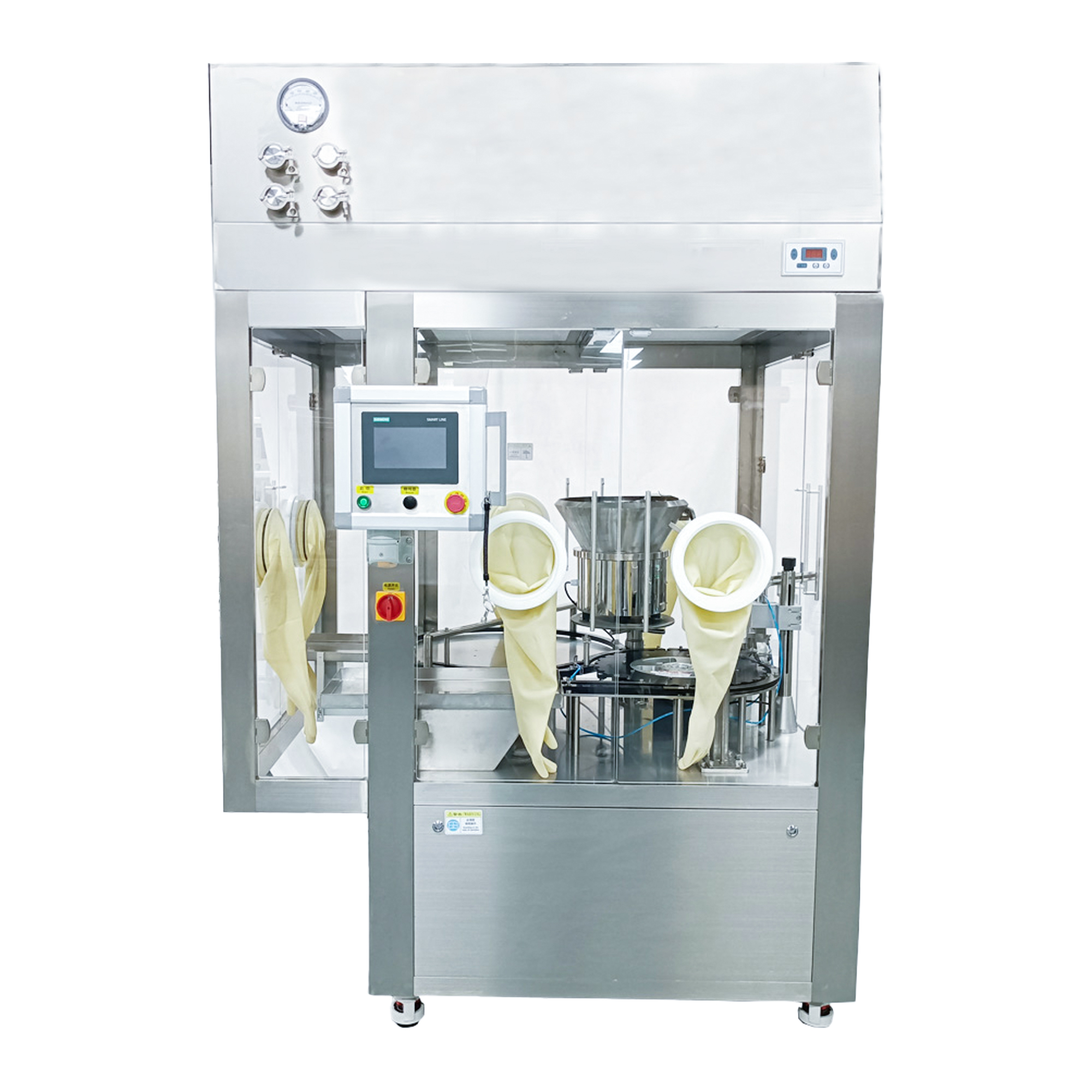
Many enterprises mistakenly believe that "having an aseptic workshop is enough", but they overlook the core role of equipment configuration and process control. True aseptic filling is not a single aseptic step, but a full-process closed-loop control from vial body pre-treatment to product inspection. We always take GMP standards as the core and integrate the aseptic concept into every detail of equipment design, without complex operations, to achieve full-process aseptic filling, helping enterprises easily pass GMP audits, safeguarding the product quality bottom line, and completely solving the problem of aseptic filling.